

Podcast with Jean-Francois Bobier, Partner and Director at the Boston Consulting Group
- QCR by GQI

- Jan 9, 2023
- 14 min read
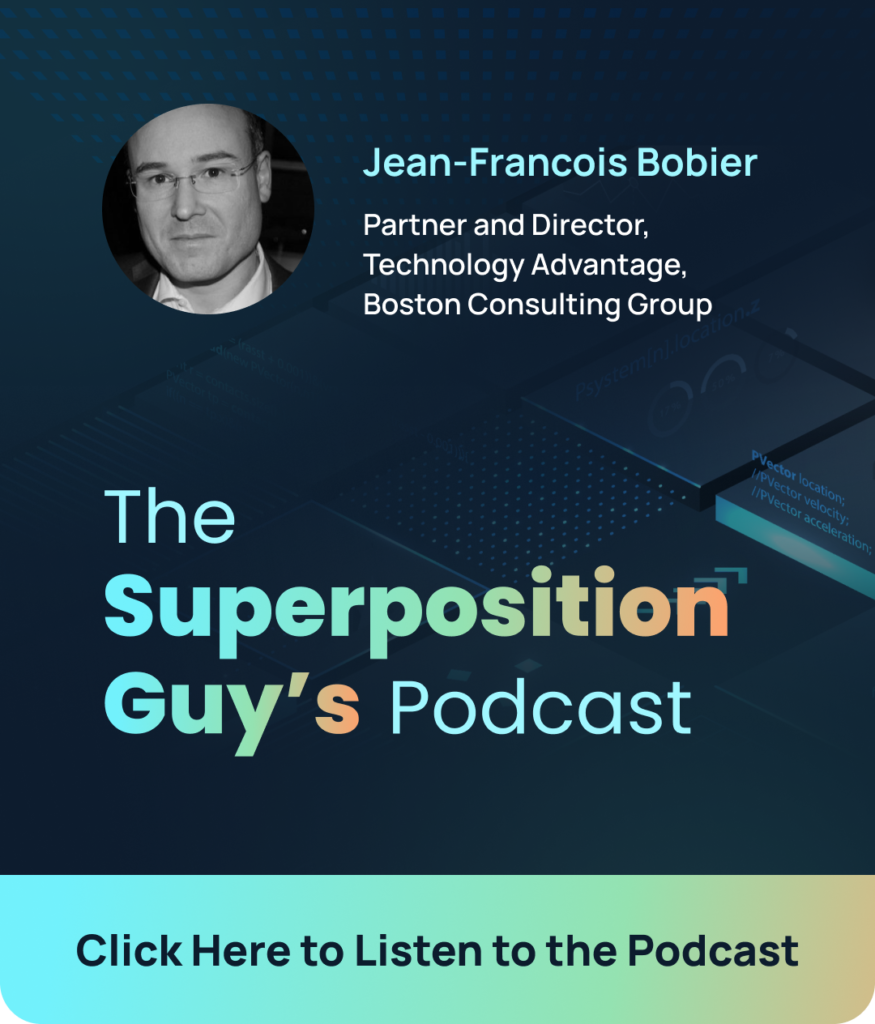
Jean-Francois Bobier, Partner and Director at the Boston Consulting Group, is interviewed by Yuval Boger. Jean-Francois and Yuval talk about a wide range of subjects, including HPC integration, venture capital investment advice, enterprise projects in quantum computing and quantum security, and much more.
Transcript
Yuval Boger: Hello Jean-Francois and thank you for joining me today.
Jean-Francois Bobier: Hello Yuval. Thank you for having me. I love your podcast, so I'm happy to be part of it.
Yuval: Thank you very much. Who are you, and what do you do?
Jean-Francois: I'm Jean-Francois Bobier. I'm a partner director at BCG, which is a strategy and management consulting company. We created a deep tech research center four years ago and I took charge of quantum computing with my colleague Matt Langione, and I've been at BCG now for 20 years.
Yuval: And you cover, I think, a lot of topics. I think you cover the Metaverse as well, but in quantum, you cover both security and computing. Is that correct?
Jean-Francois: Yeah, correct. Those are the two, let's say big opportunities that we've been working on. I would love to investigate a little bit more about what we could do with something which I think is actually a short-term opportunity. But so we prepare a publication on that topic for next year.
Yuval: Perfect. What have you learned over the last six months, whether in computing or in security? What do you know today that you didn't know in the middle of the year, perhaps?
Jean-Francois: Last week was Q2B, so which is the largest conference. And on quantum computing I had the chance to meet you in person there. I think that I came out of the conference very energized about the prospects of quantum computing. Where I learn is that there are so many companies going after the hard problems of quantum computing and I could actually see roadmaps from Google, Amazon, IonQ, Quatinuum and many of us and get some more confidence in the fact that we do have a shot at quantum Advantage in ’25, ‘26, which is I think would be great news and great acceleration for the quantum computing industry. I mean last week for me was a good confirmation for me that we on the right track and we are making the progress that we need and there are actual milestones, technical milestones behind it that these companies are built and they're executing on and that give us a lot more confidence I think.
Yuval: If I were CTO of a large company, I'm getting bombarded from all directions about things that I should be doing. Quantum is one of them. And in quantum, if I had to choose one, whether I invest in quantum computing or I invest in quantum security, what would you advise me to do?
Jean-Francois: I must say we have a French president, Mr. Macron, who would like to say you should never make a choice, actually you should do both, and I would probably say you should do both, especially if you're a large company, meaning that you have the means, the capabilities actually to take more than one topic. Quantum communications and, more importantly, post-quantum cryptography is going to be an important topic. It'll be mandated by regulations, standard bodies like NIST probably as early as 2032 or some around that time in and with probably a due date for the final migration probably around 2035. And that doesn't give a lot of runway for large companies actually, we estimate that they will probably need as it took them for Y2K, it'll probably take them a decade to transition from the established standards to the new PQC standards. Just because there are so many things in there and so many things that have been accredited for so long time.
We have to keep in mind that RSA and DSA, have been around for four decades, so they are very entrenched in the landscape certificates and so on. It'll take a long while to, I would start thinking about at least the new projects and applications, I will start making them compliant with PQC and crypto agility. Meaning that I would also prepare for a future where maybe the new protocols are not true, and maybe if I need to change them I can change them. Is this, that would be one thing. And obviously and you are part of the industry so you will probably know that answer very well. I would say that if you are in an impacted industry, so for example, financial services, pharmaceutical materials, I would definitely advise to prepare for quantum advantage, which we believe will happen around ‘25, ‘26. And which means that a lot of people will suddenly be interested and there will be competition for talent and scary resources, so it's better to get prepared now, I think.
Yuval: And by the way, speaking of these large companies, is it the same person that handles both the computing and the security side, or are there two different executives?
Jean-Francois: Actually, it's even more than that, there are many executives involved, and that's probably the difficulty of quantum computing programs and roadmaps. In large companies, for example, if you are in the bank and the benefit of quantum computing will lie somewhere, for example, in option pricing, you will need to have the people on the business side of option pricing of the traders, the people involved in, I don't know, fixed income or derivatives to be strongly involved. If just the IT department, it won't be enough. If it is just some research R&D team, it won't be enough. It has to be a joint effort between multiple departments. But the benefit, the beauty of the technology that is, but also it'll require the collaboration from everyone involved. Obviously, the main buyer will probably be IT department, especially in banks where they have large IT budgets in the billions of dollars, so we can afford quantum computing, but it'll require collaboration from averse. Say cyber security is in the purview of IT most of the time, I would say so that would remain in the same department.
Yuval: You mentioned that the cybersecurity transformation for quantum would take at least a decade.
Jean-Francois: Correct.
Yuval: How long would it take for the computing side? I'm excited about quantum, I invite BCG to help me figure out a strategy. I pull together a team, how long before I know what I'm really doing?
Jean-Francois: Yeah, that's a very important question and I think that there will be at least two or three faces the... so first of all, obviously there will be a work around the use cases, what they are, what is feasible, and that actually you can do now and you can have a sense of what are the use cases that are relevant for you that could come first. Then we need to work on those use cases with your data, with your specific context, and that could take a lot of time. The nice thing about quantum computing is that many algorithms are publicly actually published, which is nice so you don't get started from nothing. And also, there are many open-source initiative. By the way, I support Unitary Fund, so BCG has been funding Unitary Fund, and I believe open source is really an important part of the solution.
But anyway, you will need to write, you will build on the shoulder of giants, so you will take the algorithms device by overalls, and you will build on these algorithms to your specific context, your specific problems. And that will take a lot of time and iterations to get right with your data process and everything. Once that gets right, and we could take years actually to get to a good level of satisfaction and usefulness, then you will need to put in production. You will need to integrate it within your IT, right? For example, there is a use case in automotive around getting the perfect sequence of cars in the factory. It's a NP-hard combinatorial problem. There are systems that already do that today. You'll need to unplug them where they do this optimization, plug the consumer algorithm instead, then plug it back into the production system and do it at the high speed. For example, if it's a continuous process, the quantum computer will need to give answers continuously for example. That will be more production challenge, so that's why in total, it'll take many years, we believe.
Yuval: One viewpoint that I heard at Q2B is that there's no such thing as a quantum software product company, at least not today. And the reason is that no one is truly selling the product. They're selling their experts to help you integrate, to help you develop the algorithm. And same is true about hardware. If I make a quantum computer, you probably cannot use it as you need a lot of help in putting that together. Would you agree with that viewpoint?
Jean-Francois: Yes and no. I think that if you inform me on how I can predict how quantum computing will evolve, I always try to go back in time and make a comparison with the early computing efforts in the fifties, sixties. And one thing that you could already note at that time is that the companies were actually providing systems. Systems that would combine software and hardware because at the time the chips were very limited, the RAM was very limited, the storage was very limited, not dissimilar to the situation where we are today. And it was optimized at the bit level, for example, if you take Apollo, Apollo 11 computer, I think not a single bit was unused. It, they used everything they could get out of the computer they did. If you take that analogy and you apply it to quantum, my prediction, but I might be wrong, but that the first systems that will deliver value to customers will be software plus hardware integrated systems.
And probably the hardware company that tries to combine that and try to get the most out of the hardware, for example, in the form of accelerated libraries or dedicated software that does certain tasks. I think they will deliver early value to our customers. And I don't believe that in the short term, the clean and nice separation between hardware and software will work out we'll just have to admit that we'll have too many limitations with the hardware. Long term, obviously we'll get to the same situation where we are with classical computing where we have a clear stack and I mean I use an Intel processor now, but I can use an AMD processor tomorrow. It'll be the same software we run with no problem. But here we are not at that point yet. I would say that yeah, I believe the system approach will work better and that's why we have companies like Quantinuum who basically merge, I mean they're full-stack company or IBM, they have their own software capabilities, and I could give a lot of names like that.
Yuval: Do you see the quantum computer as being part of the high-performance computing data center or do you see them still separate on the cloud with whatever provider like Braket, Azure, and so on?
Jean-Francois: There are a lot of discussions, there is a first discussion around technical feasibility, and then there's a question about acceptability from a regulatory/business standpoint. Let's look at the two things here. The first is on is it feasible to put quantum computing on the cloud? The answer is obviously yes and is because, as you know, quantum computing is slow input, slow output type of computing. You give actually very limited data to the quantum QAOA, it operates in a large space to power open. But the input you give to the machine, actually, you don't give that much input. It's not like Netflix, it's not 4K video or whatever. It's not like that. And it's definitely not something that requires low latency. However, let me just give a little caveat on that one is that as there are a lot of algorithms, the variational ones that do quantum computing, then quickly go to classical and then back to quantum and then they basically interact, so that's quite variational.
And on that one, you might want to optimize as much as you can the latency of this algorithm, even though honestly, you could argue that the preparation time of the states, the prep, the readout time of the states and stone are still high compared to just the network, the networking. But it's still an argument you might hear. Then from a purely technical standpoint, I would say that you could actually live on the cloud. I'm not actually that concerned. But now if you look at the companies working in HPC settings, and I know a lot of my clients, for example, take banking for example, they have actually regulations that force them in terms of where their data centers are located. They have to comply with very specific regulations so data cannot get go outside of certain jurisdictions and stuff like that. They can't put their computation where they want.
It's very likely, for example, I see definitely I can see banks buying their own quantum computer for at least that reason and probably for another reason, which is around security, avoiding that data could get rid or whatever. I talked also to pharmaceutical companies, same answer, but they don't want to take the risk that patented drugs can get out somewhere, and there's a high, at least in some people I talk to, let's say, preference towards having the computer in-house. You will see that data privacy will probably play an important role, but you could say that for very highly competing for intensive or national algorithms, maybe you could make a case that even from a technical standpoint, you could make sense to have a computer. In my opinion, you will have a world where it'll be hybrid, a lot of computing will be procured by cloud, and I think probably 70 to 90%, and the rest will be on-premise.
Yuval: BCG operates in multiple continents, and I know you collaborate a lot with Matt in your Boston office. You recently published a paper discussing the differences between the US and Europe in terms of quantum computing, in terms of private investments, in terms of government work, and so on. I'm curious about the end users. Do you see a big difference between the requirements and the adoption rate of enterprises in the US relative to Europe?
Jean-Francois: Yeah, thank you for mentioning this report. Basically on the supply side, what we say, and for example, we look at the private investments and that is public data that if you take North America, including Canada, North America captures close to 80% of investments in quantum computing. And that's private investments so not counting what Microsoft, Google, IBM or Amazon are doing. That comes on top. If you compare that to Europe, it's more 10 to 15% so clearly on the, let's say on the supplier side, we are the clear advantage for North America clearly just because of what I just said. Obviously, but now if you look at the users, I would say that it's a more balanced discussion. If you look at the early adopters of quantum technologies, a lot of them are actually in Europe. You look at Airbus, Total, EDF, BMW, Volkswagen, I think there's this perception in Europe, and there's two in deep tech in general that Europe has missed the digital web and has a chance to catch up with quantum and deep tech.
You will see more interest in Europe but how that, let's say angst or worry. Now if you take what the large US leaders are doing, it's still very awesome. I mean if you take just banking, the two leaders in quantum computing are clearly JP Morgan and Goldman Sachs by far. And what they are doing is just excellent. Just to give two names where I believe that what we do is world-class in quantum computing, and the proximity obviously with the suppliers will tremendously help. But I think it's a fair fight on the user side but on the supplier side.
Yuval: And I do see that in Europe there are quite a few national programs. I mean, Germany is now spending a lot of money building a quantum computer, Netherlands open the quantum House, UK, Finland, and so on. I think in your report you mentioned that perhaps many of these programs are not truly coordinated. The quantum flagship doesn't have maybe as much synchronization between them. Is that the case, did I read your report correctly?
Jean-Francois: We didn't write it implicitly, but it's clear that, I mean, let's say there's room for better coordination for sure, but I think nobody will deny it. When we did the interview, that was pretty clear, so we could do better. The question is, I still believe that some dose of competition, fair competition, which is between states, I don't think it's a bad thing actually. As long as it tells move a needle and lift all the boats, I would say it's not necessarily a problem. Could we coordinate better? Probably yes, but is it necessarily a bad thing? I don't think so. If you take the US, for example, now, even in the US you've got some federal government funding, obviously, but you've got a lot of state funding. For example, if you take Illinois, they have their own funding and if you take over all states, you will find that they also compete for funding and to get quantum computing companies in their states. I would say that it's not that different. We could do definitely better, but I don't think it's major problem.
Yuval: We're getting close to the end of our conversations, but I did want to ask you about investors. I know that BCG does a fair bit of work with investors, and just between us, what are you advising investors today to invest in? Do you think that in 2023 we will see a lot of consolidation of smaller companies into bigger ones? What's your investment thesis in quantum these days?
Jean-Francois: Well, yeah, that's a billion-dollar question. I think, first of all, we have to recognize that there are many different computing approaches that are competing and I don't think we can give a winner yet. Superconducting versus Photonics versus trapped atoms versus neutral atoms versus spin qubits. I don't think it's too early to say, Hey, technology X is going to work. What I recommend to investors is actually to have some balanced strategy where they don't bet everything on one technology. Because it might be the... and actually chances are that it won't be the right one. Just because there are five technologies so if you pick one out of five, the chance that you are good is actually not very high. Even though you could say that, obviously, there is a lot of scientific evidence pointing that way or that way, but I think it's very difficult to predict.
I recommend to have a balanced strategy, at least invest in two or three different technologies in promising companies in this technology so that's one. Second thing regarding consolidation I think is bound to happen. I mean, look at where the IT market is today, which is like, and it's a 5 trillion market and look at where the quantum computing market is today. There are just too many companies to support what we believe will be a hundred billion dollar market per year in 10 to 20 years. That's too many players to share that so consolation will happen. The question is, when will it happen? I think we probably, we will probably see, and there already been in consolidations as SuperTech has been acquired by ColdQuanta, Pasqal bought Q&Co and there have been moves similar to that, and there will be more going forward.
The question will be more when the big tech, IBM, Amazons or Microsoft or Google will make their move and when they will decide by some startup as a technology that they believe is important, and we'll start to see more consolidation at that point. Overall, I think it's still a good moment to invest in quantum computing, I think. But you need to have a balanced strategy or you need to be super sure and have information that I don't have on what technology is going to work out in the end because that is super difficult to predict.
Yuval: Jean-Francois, we are here at the dinner question. If you could have dinner with one of the quantum greats, dead or alive, who would that person be?
Jean-Francois: Yeah, so now if you give me that clearly, clearly, I mean probably like 95% of people and survival, I would probably say Fineman just because I admire the guy. He was the youngest group leader in Los Alamos. He was actually in charge of computing the size of the atomic bomb. And this is how actually realized that it was difficult to compute classically with things. The guy was funny, I could see his lecture so he also, you can have fun with a guy talking and I also liked his approach to thinking in analogies and trying to make sense of the equations because it's super hard to have. He was good at trying to get some good understanding of what's going on and giving some explanations, and I think he would be proud to see where the industry is today. And also I think the first use case that will be relevant will be probably around the original vision of quantum computing. That is simulating nature, I think is going to be the killer app at the beginning.
Yuval: And of the European greats?
Jean-Francois: European great. Oh, that's a good question. I would probably say Niels Bohr, but that's a lot to ask, but the guy just did foundational stuff.
Yuval: How can people get in touch with you to learn more about your work?
Jean-Francois: LinkedIn works very well. My email address is super easy to guess, but you can click on any publication to reach me there. There's a link to contact me and, obviously quantum computing conferences.
Yuval: Excellent. Jean-Francois, thank you so much for joining me today.
Jean-Francois: Thank you so much for your questions.
Yuval Boger is an executive working at the intersection of quantum technology and business. Known as the “Superposition Guy” as well as the original “Qubit Guy,” he can be reached on LinkedIn or at this email.
January 9, 2023

Comments